


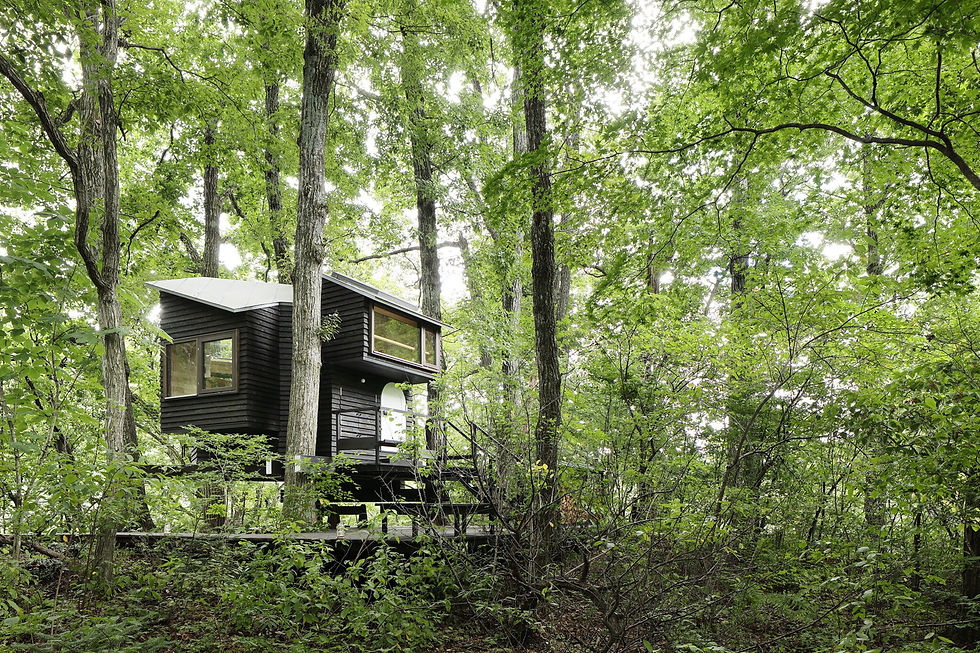
Danki
Ryu Mitarai & Associates, Architects
Project Name: Danki
Location: Kita-Karuizawa, Gunma Prefecture, Japan
Design Team: Ryu Mitarai & Associates, Architects
Total Floor Area: 10 m²
Completion: 2024
Photography: Nakamura Kai
Feature: Tokyo-based practice Ryu Mitarai & Associates, Architects, led by architect Ryu Mitarai, has completed an extraordinary timber cabin in Kita-Karuizawa, Gunma Prefecture, that redefines the relationship between minimal intervention architecture and natural environments. Built as an annex to Kazuo Shinohara's iconic Tanigawa House, this project demonstrates how precise site responsiveness and innovative structural strategies can create deeply immersive spatial experiences while preserving existing ecosystems.
Located within a mature forest grove, the site features four large mizunara oak trees whose thick roots firmly grasp the earth. Rather than employing conventional foundations that would compress the tree roots and soil environment, the architects conceived a revolutionary tree-anchoring construction method using custom anchor bolts embedded into the tree trunks, suspending the entire structure 1.5 meters above the forest floor.
The defining feature of this 10-square-meter retreat is its innovative spiral window alcove configuration. Centered around a wood-burning stove, Ryu Mitarai created four distinct viewing niches at varying heights with contrasting characters, named "Valley Window," "Mountain Window," "Nest Window," and "Dappled Light Window." These small pocket spaces derived from bodily proportions unfold spirally upward, each framing specific aspects of the diverse surrounding environment, from distant mountain vistas to dappled sunlight filtering through the canopy.
Each window's form and opening mechanism is determined by its surrounding environment, endowing the architecture with a lightness akin to adjusting clothing to regulate environmental conditions. When the central stove burns, height differentials generate significant thermal environmental variations. Opening windows slightly allows cool breezes from the forest and valley to flow across the body, delivering ineffable refreshment. This strategic design creates layered sensory experiences, making the cabin feel like an extension of the human body, as if wearing the environment itself.
The interplay between window alcove spaces and natural environment produces spatial depth that transcends its modest footprint. Through meticulous observation of site-specific conditions, the architect created architecture that both warms the body when fire burns and maintains connection with nature during non-heating periods. This project demonstrates how minimized construction intervention and deep environmental responsiveness can create living spaces filled with vitality that coexist symbiotically with their sites.
Design Team: Ryu Mitarai & Associates, Architects stands as a distinguished representative of contemporary Japanese architectural practice, founded in Tokyo in 2013 by architect Ryu Mitarai, having established a pioneering reputation in contemporary architectural design and dynamic order architectural language innovation since its founding. This practice based in Meguro, Tokyo redefines contemporary Japanese architects' role in design discourse through designing architecture that responds to fluctuating natural environments.
Ryu Mitarai brings exceptional environmental responsiveness design perspectives and deep understanding of bodily perception space to architectural practice. The practice has garnered recognition for its commitment to harmoniously integrating projects with natural environments and creating spatial experiences that evoke human activity. Ryu Mitarai, born in Tokyo in 1978, graduated from the University of Tokyo's Department of Architecture in 2002 under Tadao Ando's mentorship and completed graduate studies at the University of Tokyo Graduate School of Engineering's Architecture Department in 2004. He subsequently spent nine years at Toyo Ito & Associates, Architects, accumulating extensive practical experience before establishing his independent practice in 2013. His teaching engagement encompasses adjunct lecturer positions at prestigious institutions including Yokohama National University Graduate School Y-GSA, the University of Tokyo, Hosei University, Japan Women's University, and Musashino University.
The firm's design philosophy emphasizes that architecture should shift from "easy to use" to "want to use," creating lively places by stimulating people's physical senses and evoking activity. The practice believes that by responding to ever-fluctuating natural environments, architecture can create new natural states, and architecture generated from dynamic order will produce richness. Through deep attention to site-specific recognition and spatial continuity, working across diversified works from residential housing to public architecture and interior design.
The practice has achieved significant recognition within the architectural community, with Grove receiving the 2024 Residential Architecture Award and 2024 Japan Institute of Architects Award, and being selected as a finalist for the 2025 Architectural Institute of Japan Prize and included in the AIJ Selected Architectural Designs. Miraton received the 2024 Tokyo Architecture Award, 2025 AIJ Prize for Architectural Design, and 2023 Good Design Award. The practice also received the SD Review Kajima Prize in 2022 for Grove and has been selected as a finalist in multiple significant architectural competitions.
Beyond practice, through precise grasp of spatial scale, in-depth research on bodily perception, and continuous exploration of environmentally responsive architecture, Ryu Mitarai & Associates, Architects has established itself as a significant contributor to contemporary Japanese architectural discourse, creating architectural works that are both environmentally responsive and maintain architectural excellence. Under the continued leadership of Ryu Mitarai, the firm currently occupies a unique position within Japan's architectural landscape, focusing on creating architectural spaces filled with vitality that emerge from dynamic order.
10 m²
Kita-Karuizawa, Japan
2024


