


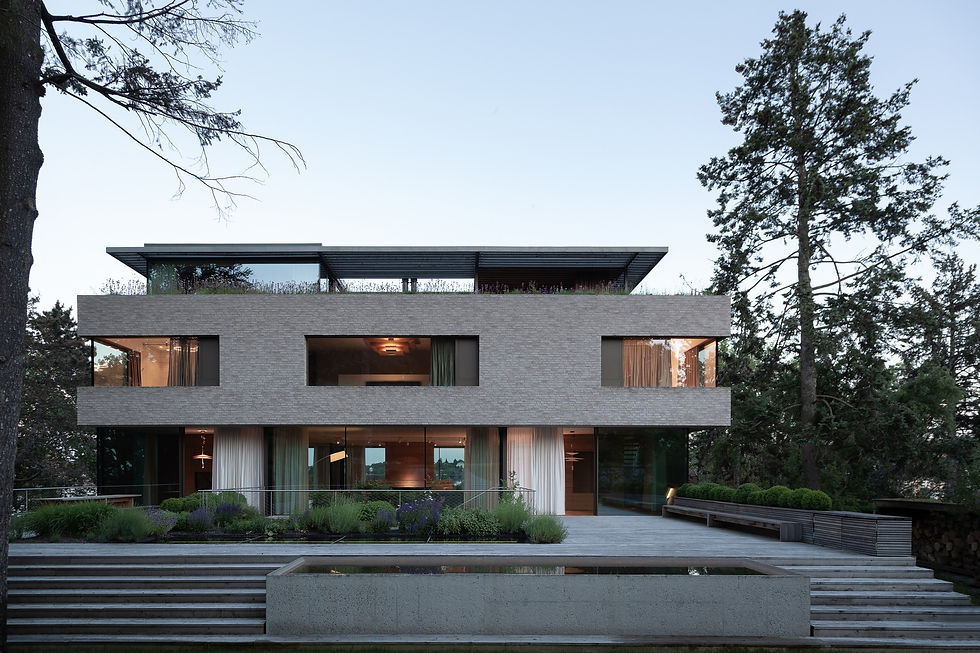
Villa Vista
Znameni Ctyr Architekti
Project Name: Villa Vista
Location: Hanspaulka District, Prague, Czech Republic
Design Team: Znameni Ctyr Architekti
Total Floor Area: 1,200 m²
Completion: 2020
Photography: Alex Shoots Buildings, Veronika Raffajova
Feature: Znameni Ctyr Architekti's Villa Vista demonstrates how vertical layering concepts and landscape integration design philosophy can transform a five-storey residence on a sloped plot into a contemporary living masterpiece of sculptural presence and spatial fluidity.
This 1,200-square-meter residence dramatically sits upon sloping terrain in Prague's historic Hanspaulka villa quarter, presenting itself as a profound exploration of contemporary residential typology integration, material expression, and architectural layering strategy fusion. Through carefully considered volumetric composition and spatial organization, it creates a living experience that seamlessly weaves functionality with panoramic vistas.
The project's most compelling design feature lies in its fundamental response and reimagining of ingenious five-block stacking. Confronting the complex conditions of a sloped plot and historical garden park, the architects employed a cascading strategy, creating an architectural work that explores the relationship between solid and void. This design strategy creates formal purity of architectural form, achieving a sculptural volumetric effect that allows the architecture to display light elegance among mature trees.
Znameni Ctyr Architekti's design language fluently expresses contemporary Czech architectural vernacular, employing strategic material contrasts and spatial vertical connections to redefine living experiences within sloped terrain. The residence's lowest level is wholly cut into the terrain, accommodating entrance and parking functions, extending to an exterior granite-covered yard. The second storey is also partly submerged, forming the masonry pedestal of the house and the largest floor area. This bold embedding strategy not only lightens the building's visual impact on the environment but cleverly accommodates the natural slope of the terrain.
Most remarkably, the architects create an honest material system through clever manipulation of fully-glazed central living space and solid masonry blocks. The main living space situated on the masonry pedestal is full of natural light, surrounded on all sides by mature trees. This transparent center opens up into the lower and higher levels of the house via two inner galleries, connecting the residence's low and high floors. Above this fully-glazed central living space, one finds a levitating sculpture-like mass, echoing the lower, partially submerged second storey. Both of these massive blocks of well-balanced proportions feature horizontal corner windows, designating living space which opens up towards exterior separated only by glazing.
The residence is organized into five main levels, each with clear functional positioning. The ground floor is wholly cut into the terrain, handling entrance and parking requirements. The second storey is partly submerged, forming the largest floor area and masonry pedestal. The third level is the fully-glazed main living space, becoming the visual and functional center of the house. The fourth storey includes the atrium in the large terrace behind the house, based on the same principle of visual interconnection. The highest level is the roof terrace with a small wholly glazed superstructure, serving as a vantage point, surrounded by a roof garden with perennials.
Material strategy continues this harmonious coexistence design philosophy between architecture and context. The brick face of irregular brick joint accentuates the horizontality of the whole architectural composition, contrasting with glazed volumes. Integration with context is reinforced through the use of primary materials, including the tactile texture of masonry, the transparency of glass, and the robustness of granite. The project strategically organizes openings to capture panoramic views while providing natural screening through mature trees. The house doesn't project into the garden, but allows itself to be surrounded and interpenetrated by the garden, demonstrating Znameni Ctyr Architekti's commitment to site sensitivity and landscape integration.
Garden design adopts a dual strategy approach. The front street and formal part of the garden is reminiscent of French geometric style, composed of horizontal strips of perennials and box trees. Behind the hedge of shaped yew trees, one finds a private garden space designed in the natural English park style. This contrasting landscape design reinforces the architectural transition from public to private, creating a seamless dialogue between architecture and nature.
Design Team: Znameni Ctyr Architekti stands as a distinguished representative of contemporary Czech architectural practice, founded by three partners in 1999. Under the leadership of principal architects Juraj Matula, Richard Sidej, and Martin Tycar, it has established a pioneering reputation in contemporary residential design and interdisciplinary design approach innovation. This Prague-based practice redefines contemporary Czech architects' role in international design discourse through coordinated integration of design and technical precision.
Znameni Ctyr Architekti brings exceptional diversified design perspectives and deep understanding of 3D BIM technology approaches to architectural practice. The practice has garnered recognition for its commitment to harmoniously integrating projects with site context and functional requirements, creating spatial experiences that transcend purely functional limitations. Its design methodology demonstrates sophisticated engagement with fundamental architectural elements, believing that experience with different themes from architecture to furniture design greatly contributes to work quality.
The firm's design philosophy emphasizes that architecture should transcend formal limitations, designed not merely to satisfy functional requirements but to organically merge with site conditions and client identity. Through deep attention to site-specific recognition and spatial continuity, working on innovative explorations of residential typologies, they believe the best architecture results from team-collaborative interventions through precise and thoughtful processes. Znameni Ctyr Architekti believes architecture should serve as a carrier of inhabitants' lifestyles, creating unique architectural experiences through strategic spatial organization and material selection.
Beyond practice, through thoughtful application of the latest building technology, geometric precision and volumetric purity application, and comprehensive 3D BIM Revit documentation processes, Znameni Ctyr Architekti has established itself as a significant contributor to contemporary Czech architectural discourse, creating architectural works that are both technically innovative and maintain architectural excellence. Their Science and Research Center of Charles University was selected as a pilot project by the Ministry for implementing 3D BIM in public administration, demonstrating their technical leadership. Under the continued leadership of the three partners, the firm currently occupies a unique position within the Czech Republic's dynamic architectural landscape, focusing on creating spatial experiences that achieve architectural quality through material integration, spatial verticality, and contextual sensitivity.
Over twenty years, Znameni Ctyr Architekti has demonstrated remarkable versatility, with a portfolio encompassing residential compounds, educational facilities, cultural buildings, and interior commissions. Each project reflects a commitment to craftsmanship and detail, emphasizing collaborative teamwork from project inception. Their notable works, including the Smíchov Synagogue reconstruction and Albertov Campus expansion, exemplify their ability to balance contemporary architectural language with respect for historical context, establishing their position as one of the Czech Republic's most respected architectural practices.
1200 m²
Prague, Czech Republic
2020


