


Pujiang Platform
MVRDV
Project Name: Pujiang Platform
Location: Chengdu, China
Design Team: MVRDV
Floor Area: 414 m²
Completion Year: 2025
Photography: Arch-Exist
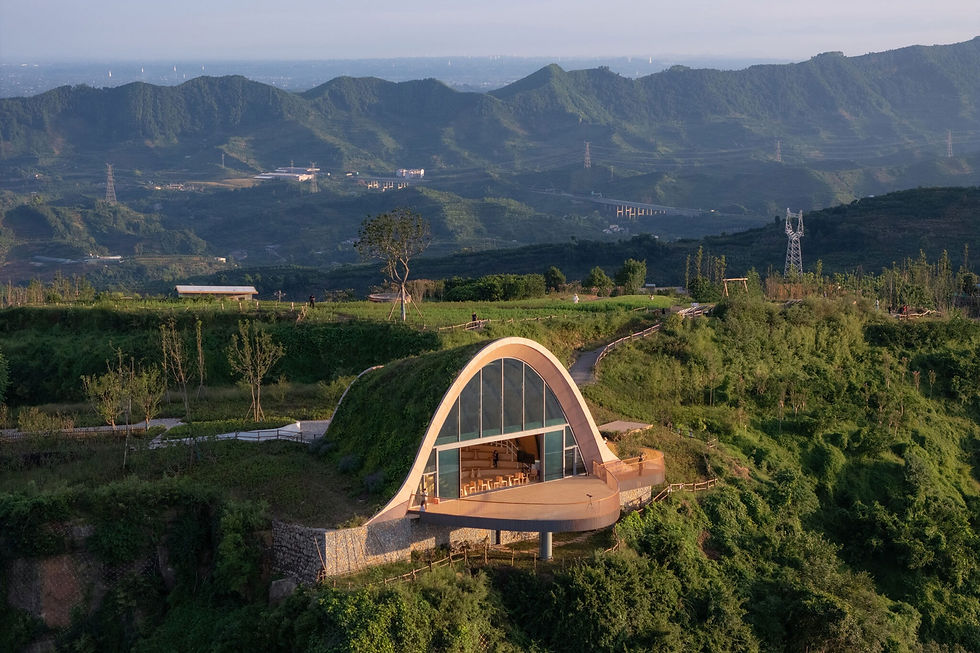
Feature: Dutch architecture studio MVRDV has completed the Pujiang Platform, an earth-covered timber pavilion that rises from the hills south of Chengdu, China, as both a tourist destination and multifunctional event space. The project stands out for its poetic response to site history, architectural restraint, and commitment to sustainable construction methods.
The design emerged from a striking discovery: the original hilltop had been leveled during construction of a previous viewing platform. Rather than simply building another structure, MVRDV conceived an arched pavilion cloaked in earth and vegetation that reconstructs the hill's former profile. This gesture of environmental restoration defines the project's essence, creating architecture that simultaneously disappears into and enhances its landscape.
The building's telescopic form draws visitors through layered spatial experiences. Entry occurs via a modest glass facade tucked into the earthen berm, opening into an interior where sloping floors and ceilings follow the hillside's natural gradient. This creates an amphitheater-like tribune ideal for presentations or quiet contemplation. The journey culminates at a ten-meter-tall glass wall with oversized sliding doors that dissolve boundaries between interior and exterior, connecting to a dramatic cantilevered balcony overlooking the Qionglai Mountain range.
MVRDV's use of timber construction serves dual purposes: reducing embodied carbon while demonstrating wood's viability within China's construction industry, which remains cautious about large-scale timber adoption. The architects complemented this structural choice with comprehensive passive strategies, including the insulating earth berm, natural ventilation through layered ceilings, strategic solar orientation, and geothermal heat pumps.
A twisting staircase leads to a secondary circular viewing platform, completing a looped pathway system that improves site circulation. At night, light emanating from the pavilion's windows transforms it into a beacon visible from the plains below, creating a landmark that honors rather than dominates its spectacular natural setting.
Design Team: Founded in 1993 by Winy Maas, Jacob van Rijs, and Nathalie de Vries, MVRDV has established itself as one of the most influential architecture firms globally. Based in Rotterdam with additional offices in Shanghai and Paris, the practice employs over 250 architects, designers, and specialists who apply rigorous technical expertise and innovative research methodologies to every project.
MVRDV's design approach is fundamentally rooted in research and multidisciplinary collaboration, engaging experts, clients, and stakeholders throughout the creative process. This methodology yields bold, direct architectural solutions spanning urban planning, building design, and landscape architecture. The firm's portfolio demonstrates exceptional versatility, from pioneering projects like the Dutch Pavilion at Expo 2000 Hannover and Rotterdam's Market Hall to transformative urban interventions such as Tianjin Binhai Library and Seoul's Seoullo 7017 skygarden.
The practice distinguishes itself through parametric urbanism and data-driven design strategies that address contemporary challenges of urban density and sustainability. Their theoretical investigations, published in seminal volumes including FARMAX (1998), MetaCity/Datatown (1999), and The Vertical Village (2012), have shaped international discourse on future cities. Current projects across Europe, Asia, and North America continue this legacy of innovation, combining environmental responsibility with spatial ingenuity. Under the continued leadership of its three founding partners, MVRDV maintains an unwavering commitment to high design standards while pioneering new possibilities for architecture's role in shaping equitable, sustainable urban futures.
414 m²
Chengdu, China
2025


