


Louis Vuitton Visionary Journeys Seoul
OMA / Shohei Shigematsu
Project Name: Louis Vuitton Visionary Journeys Seoul Exhibition
Location: Seoul, South Korea
Design Team: OMA / Shohei Shigematsu
Exhibition Area: 1,300 m²
Opening: November 2025
Feature: OMA partner Shohei Shigematsu's "Visionary Journeys Seoul" exhibition demonstrates how innovative spatial strategies and flexible exhibition systems can transform a traditional department store into a dynamic connector merging retail, culture, and public experience, creating an immersive brand narrative space spanning six floors.
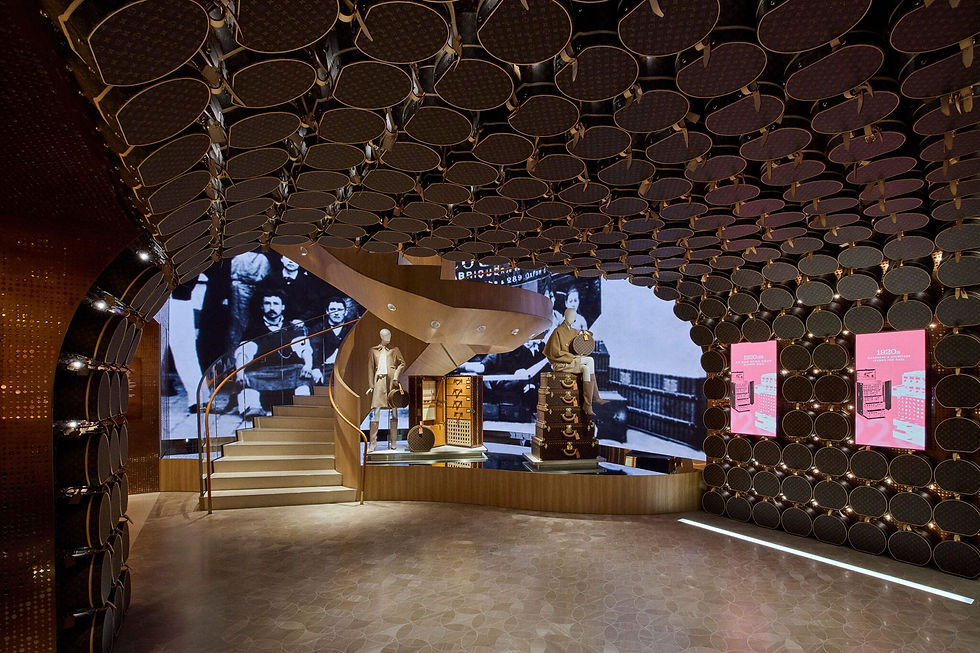
This 1,300-square-meter exhibition located within Shinsegae Department Store's main branch serves as the cultural anchor of Louis Vuitton's new multi-level experience, "LV The Place Seoul." The project responds to the brand's need to deploy a large-scale cultural exhibition within a historic retail building. Unlike previous "Visionary Journeys" iterations in Bangkok and Shanghai, the Seoul edition marks the first time the exhibition inhabits the architectural fabric of a century-old department store. The design challenge lay in creating a spatial sequence capable of showcasing over 200 Louis Vuitton pieces while maintaining the building's historic character and achieving open connections between exhibition spaces, retail floors, cafes, and public corridors.
The core design strategy conceives the exhibition as a "connector between retail and public space." The architects leveraged the department store's existing floor configuration and historic stair atrium to create a non-linear spatial experience. Eleven themed galleries, half of which debut here for the first time, and two major installations open onto other rooms and programs through multiple entries, breaking the traditional single circulation path and allowing visitors to freely choose their exploration routes.
OMA's design language fluently expresses the balance between thematic specificity and openness. The exhibition begins on the fifth floor with "Origins," where brand history coalesces as a cloud of artifacts, documents, and cutouts on a faceted wood armature evoking traditional Korean screens. The ground level features a vaulted "Trunkscape" installation constructed from 270 Boite Chapeau hat boxes, forming an immersive portal guiding visitors into the Louis Vuitton store. Exhibition spaces encompass diverse curatorial strategies: "Watches" presents a chronological display of Louis Vuitton-designed timepieces, with motifs from watch trunks transforming into panels and screens wrapping the room; "Picnic" creates an "outdoor" atmosphere where portable trunks, tableware, and camping cars are staged on a lawn; "Personalization" disassembles customized luggage to create a gallery-like archive showcasing one-of-a-kind pieces.
Craftsmanship-themed galleries reveal Louis Vuitton's exceptional artisanship. "Workshop" recreates the Asnieres atelier as both a set for live demonstrations by craftspeople and a gallery of sketches and tools. "Test" brings laboratory scenes to public view through machines performing live tests on various bags for strength and durability. "Icons" presents iconic leather goods creations over time in a kaleidoscopic field of floor-to-ceiling vitrines. "Monogram" captures a playful array of forms—bags shaped like animals, nautical ephemera, and other unexpected objects—as templates cut out from a floor-to-ceiling Monogram wall wrapping around the room.
The central atrium features towering light structures guiding visitors down to the fourth-floor exhibition area. Monogram hanji "trunks" are vertically stacked in different configurations and illuminated from within, creating column-like lanterns suspended from the ceiling. Fourth-floor galleries explore Louis Vuitton as a platform constantly generating new modes of artistic expression. "Music" highlights Louis Vuitton-designed musical instruments, cases, and speakers in an anechoic chamber. In "Collaborations," artist-designed bags revolve on a carousel as their artworks are amplified on digital screens and reflected on a wall of mirrored bags, transforming the room into a mercurial canvas. "Fashion" compiles worlds built by successive creative directors—snapshots of looks, mood boards, set designs, and runways flicker across a split-flap display.
Material strategies reinforce the exhibition's narrative layers. Exhibition structures are sometimes expressed outward like shop "facades," creating dialogues with the department store's historic stair atrium. Multiple entries generate views into other rooms and programs, allowing visitors to break from linear procession. Select galleries are designed for adaptability to accommodate future content and events over the exhibition's extended duration, responding to Louis Vuitton's spirit of invention and cultural agility.
Spatial organization strategies prioritize the diversity and continuity of brand narrative. By opening thematic environments onto the historic stair atrium, the design creates dynamic sightlines revealing the multiplicity of Louis Vuitton's creativity. The wraparound circulation not only provides diverse viewing experiences but also reinforces the exhibition's continuous dialogue with the department store's retail spaces and public corridors. This design approach creates a spatial environment evoking both strong cultural character and commercial vitality, synthesizing display, interaction, and commercial requirements into a harmonious spatial whole.
Design Team: OMA, founded in 1975 by Rem Koolhaas, is an internationally renowned architectural practice operating at the intersection of architecture, urbanism, and cultural research. Currently led by seven partners including Rem Koolhaas, Reinier de Graaf, Shohei Shigematsu, Iyad Alsaka, Chris van Duijn, Jason Long, and Managing Partner-Architect David Gianotten, the firm maintains strategic offices in Rotterdam, New York, Hong Kong, and Australia.
OMA has established itself as a pioneer in contemporary architecture through its rigorous approach to spatial innovation and programmatic complexity. The practice's portfolio encompasses diverse typologies, from cultural institutions to urban master plans, demonstrating exceptional versatility across scales and contexts. Notable completed projects include CCTV Headquarters in Beijing (2012), Seattle Central Library (2004), Casa da Música in Porto (2005), Fondazione Prada in Milan (2018), Axel Springer Campus in Berlin (2020), and more recently, Buffalo AKG Art Museum (2023), Aviva Studios in Manchester (2023), and Toranomon Hills Station Tower in Tokyo (2023).
OMA's research arm, AMO, extends architectural thinking beyond conventional boundaries, engaging with fashion, branding, and cultural strategy. AMO has collaborated with Prada since 2001, designing the brand's Epicenter stores in New York and Los Angeles, and has been responsible for designing the brand's runway shows since 2004. AMO has also worked with Universal Studios, Amsterdam's Schiphol Airport, Heineken, Ikea, Condé Nast, Harvard University, Stone Island, and others, and has curated "Countryside: The Future" at the Guggenheim Museum and multiple exhibitions at the Venice Architecture Biennale. This dual structure enables comprehensive design solutions synthesizing spatial design with broader cultural discourse.
Shohei Shigematsu, as a partner at OMA's New York office, has led the design of multiple cultural and commercial projects, including Milstein Hall at Cornell University, Faena Forum in Miami, and Audrey Irmas Pavilion in Los Angeles. For this project, Shigematsu led the design team with Project Leader Jesse Catalano, including Benedetta Gatti, Blake Kem, Eugene Kim, Niccolo Baldi, Francesca Parmiggiani, Titouan Chapouly, and Vicky Cao.
Under Shigematsu's leadership, OMA employs rigorous contextual analysis and innovative spatial strategies, prioritizing diversity of spatial experience alongside cultural narrative depth. The firm's design process is characterized by responsiveness to site-specific parameters and technical precision, while maintaining commitment to material authenticity, spatial fluidity, and programmatic innovation. OMA's work encompasses cultural, commercial, and urban design typologies, demonstrating adaptability to diverse environmental conditions and cultural contexts, with designs consistently dedicated to creating spatial environments transcending formal trends and focusing on timeless qualities of narrative, experience, materiality, and human interaction.
1300 m²
Seoul, South Korea
2025


