


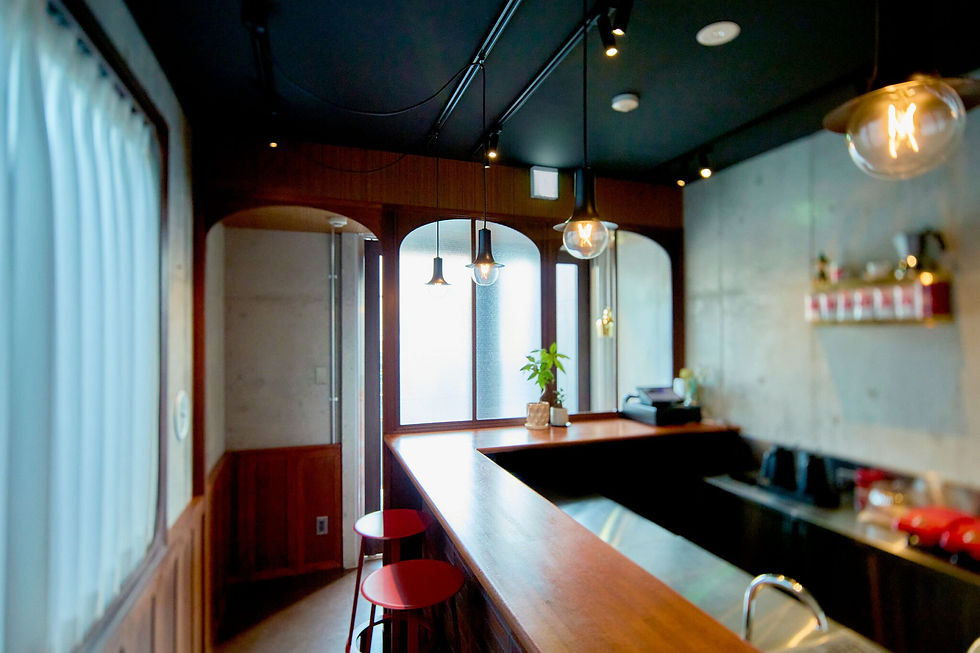
Jiyugaoka Pure Coffee Shop
Tsubame Architects
Project Name: Jiyugaoka Pure Coffee Shop
Location: Tokyo, Japan
Design Team: Tsubame Architects
Total Floor Area: 16.8 m²
Completion: August 2025
Photography: Eri Kawamura
Feature: Tsubame Architects has completed a four-seat coffee shop in Tokyo's Jiyugaoka district, designed to evolve and mature into a traditional Japanese pure coffee shop over time rather than artificially recreating a nostalgic aesthetic from the outset.
Located five minutes from Jiyugaoka Station along the railway tracks, the 16.8-square-metre café challenges conventional approaches to designing spaces with historical character. Instead of constructing an overtly retro environment that might feel contrived, the architects conceived a space that will naturally accumulate patina and character through years of use. This design philosophy is rooted in a profound understanding of the concept of pure coffee shop, which in contemporary Japan signifies not merely a coffee establishment but embodies accumulated time and community memory. Recognizing that deliberately replicating aged qualities would produce inauthentic spatial experiences, the architects chose to create a genuine foundation that would truly mature alongside its community over time.
The design strategy centers on a continuous counter running the length of the narrow interior, facilitating intimate face-to-face interactions between proprietor and customers. This linear arrangement maximizes the compact footprint while creating surprising spatial depth through deliberate partitioning. At the entrance, a brick base wall paired with semi-transparent arched windows serves dual purposes, enabling takeaway service whilst providing visual privacy for seated guests, cultivating a hideaway atmosphere within the modest space. The intentional segmentation generates a sense of depth that belies the café's diminutive dimensions, with carefully orchestrated spatial layers making the 16.8-square-metre space feel far more expansive than its actual measurements.
The counter, positioned as the project's conceptual and physical centerpiece, incorporates materials that have already weathered naturally, including aged timber and brick. This strategy allows the new construction to harmonize with its surroundings whilst embracing beneficial patina over time, avoiding the artificiality that often accompanies deliberately aged designs. The architects leveraged the inherent qualities of these materials that have already spent time in nature to construct a warm counter that naturally integrates with its environment while displaying the marks of time in a positive manner. The grain of the timber, the texture of the brick, and their compositional relationships all narrate stories of time while providing a stage for the accumulation of future narratives.
The resulting interior achieves a paradoxical quality, simultaneously new yet somehow familiar, as though it has always occupied this site. This approach redefines the concept of pure coffee shop for contemporary contexts, creating an authentic foundation that will genuinely mature alongside its community rather than masquerading as something already old. Through this thoughtfully considered design methodology, Tsubame Architects demonstrates how contemporary architecture can engage in dialogue with historical tradition without sacrificing authenticity. The project proves that newness and tradition are not opposing concepts but can be harmoniously unified through profound understanding of materials, temporality, and use. The architects anticipate that through continued use and the accumulation of shared experiences, the space will authentically transform into the pure coffee shop envisioned at its conception, allowing time to become the ultimate and most significant design element.
Design Team: Founded in 2013 by Takuto Sando, Motoo Chiba, and Himari Nishikawa, Tsubame Architects has established itself as an award-winning practice that fundamentally reconsiders architectural processes through integrated design and research methodologies. The Tokyo-based firm, currently directed by its three founding partners, has garnered significant recognition including the 34th JIA Newcomer Award, the 48th Tokyo Architecture Award Grand Prize, and multiple Good Design Awards.
The practice operates through a distinctive dual-division framework. The DESIGN division executes spatial design and supervision, while the LAB division conducts research into project frameworks during pre-construction phases and develops utilization strategies post-completion. This cyclical methodology between divisions enables the firm to discover what they characterize as new balances in architecture, generating contextually appropriate spatial proposals. Central to Tsubame Architects' philosophy is a foundational inquiry established at each project's genesis: What kind of spaces should we be creating in this place at this time? This question-driven approach ensures collaborative premise-setting with clients, anchoring design strategies in specific temporal and spatial conditions rather than predetermined aesthetic paradigms.
Registered as a first-class architectural firm under Tokyo Metropolitan Governor Registration Number 62479, with Motoo Chiba serving as managing architect (MLIT Minister Registration Number 362313), the practice maintains rigorous professional accreditation whilst advancing experimental spatial concepts. Operating from their Setagaya office, the firm provides design and supervision services nationwide with multilingual capabilities. Their portfolio demonstrates particular excellence in public and cultural facilities, encompassing project types including community centers, roadside stations, and educational buildings.
Takuto Sando was born in Fukushima Prefecture in 1982, graduated from Yokohama National University's Faculty of Engineering in 2006, and completed his studies at Yokohama Graduate School of Architecture (Y-GSA) in 2009. Before establishing Tsubame Architects, he worked at NL Architects in the Netherlands and served at NAP Architects until 2014. Motoo Chiba was born in 1977 and accumulated extensive international experience in New York. Himari Nishikawa, as a founding partner, collaboratively shapes the firm's design direction alongside her two partners.
Through in-depth research on site specificity, innovative use of materials and temporality, and continuous exploration of cultural heritage, Tsubame Architects has established itself as a significant contributor to contemporary Japanese architectural discourse, creating architectural works that are both environmentally responsive and maintain architectural excellence. Under the continued leadership of Takuto Sando, Motoo Chiba, and Himari Nishikawa, the firm currently occupies a unique position within Japan's architectural landscape, focusing on creating architectural spaces filled with vitality that merge traditional wisdom with contemporary technology. Tsubame Architects is committed to viewing architecture as dynamic equilibrium rather than static form, continuously exploring the role architecture should play in contemporary society through their distinctive dual-division working methodology, contributing works of forward-thinking vision and cultural depth to both Japanese and international architectural communities.
16.8 m²
Tokyo, Japan
2025


