


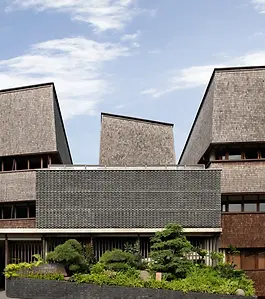

Experimental House with a Large Roof
Architectural Atelier DADA
In Sendai, Architectural Atelier DADA gathers a 162.91 m² timber house and its courtyard beneath one large roof, using Akiu stone, a slatted upper floor and high skylights to shape an evolving domestic environment of light, air and planting on an ordinary residential plot.

Black Country Living Museum Visitor Centre
Napier Clarke Architects
In Dudley, Napier Clarke Architects shapes a 1500 m² museum gateway from three staggered zinc-clad gables, connecting the tram circle, woodland and open-air exhibits through a cantilevered deck, a hillside lower level and naturally ventilated public interiors.

Tiima Museum and Science Centre
OPUS Architecture + Simon Mahringer
In Oulu, OPUS Architecture and Simon Mahringer connect a historic power station with two brick volumes, an open loggia and a museum square, shaping a 9,540 m² museum and science centre where science, urban memory and public life unfold along a shared path through time.

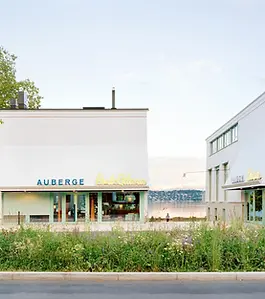

Mata do Paraíso Scout Park
Plano Humano Arquitectos
Within a 19-hectare woodland in Vialonga, Portugal, Plano Humano Arquitectos uses 355 m² of timber structure and translucent polycarbonate to organise three scout facilities, placing changing, washing and camping support beneath continuous colonnades and gently curving roofs.
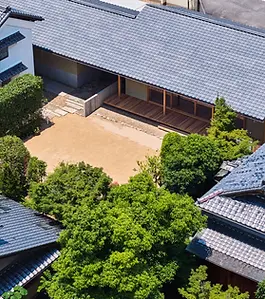
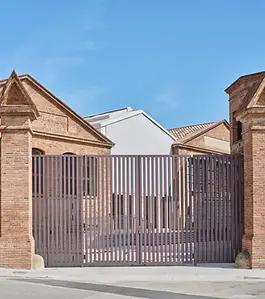


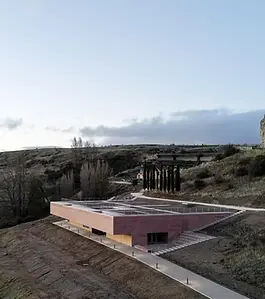
Clunia Visitor Center
Tejedor Linares Arquitectos
At the Roman site of Clunia in Spain, Tejedor Linares Arquitectos embeds the 1,325 m² visitor center into the slope leading toward the theatre, using a planted roof, ochre concrete, a water court and horizontal views to turn arrival into a gradual passage from the present surface toward deeper history.

Gisors Cultural Hub
richter architectes et associés
At the 2,650 m² Gisors Cultural Hub in France, richter architectes et associés links a three-screen cinema, media library and public park with an east-west riverside gallery, placing flood-resilient parking below so the River Epte can return to everyday urban life.
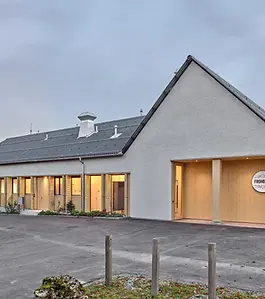
Restaurant Frohberg
Peter Moor Architects
On a vineyard slope in Stäfa, Peter Moor Architects reimagines Restaurant Frohberg as two intersecting pitched-roof volumes, where weighty gables, open colonnades and folding larch shutters frame Lake Zurich and renew the site's tradition of dining, celebration and day trips.
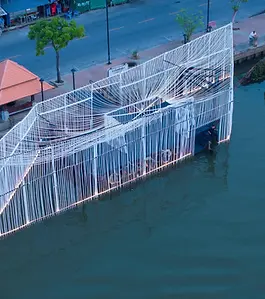

Media Library and Music School
Dominique Coulon & Associés
In a 2,173 m² public cultural complex in Sarlat-la-Canéda, Dominique Coulon & Associés uses a retained factory wall to connect a new media library with a renovated music school, shaping ochre concrete, a cliff-carved reading cave, courtyards and a public terrace into an inhabitable urban terrain.
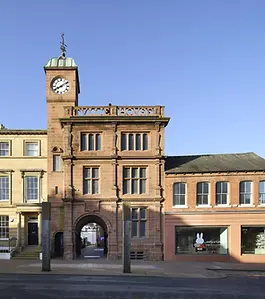


Livraria da Vila Artes
ARCHITECTS OFFICE
Inside a 40 m² São Paulo bookshop, ARCHITECTS OFFICE frames a continuous Klein-blue interior with a restrained off-white shell, using perimeter shelves, central displays and diffuse overhead light to turn a pause in the mall into an experience closer to a gallery.

Pizza 4P's Thao Dien
studio anettai
Inside a 560.8 m² former villa in Ho Chi Minh City, studio anettai reorganises Pizza 4P's flagship through retention, stripping, returned earth and lightweight shade, allowing edible gardens, wetlands, old fabric and split levels to form an ecological setting that continues to grow.

30 Grosvenor Square
David Chipperfield Architects
At the 48,000 m² former US Embassy in London, David Chipperfield Architects restores Saarinen's Portland-stone facade and concrete diagrid, removes accumulated security boundaries, and introduces an atrium, public piano nobile and set-back crown to reconnect the hotel with Grosvenor Square.

L’ARIA Restaurant
Herzog & de Meuron
At a 730 m² hotel restaurant on Lake Como, Herzog & de Meuron retains the existing greenhouse and extends five metres into the garden. An opening veranda, trellis shadows, cast-glass ceiling, walnut and two marbles reconnect the formerly enclosed dining rooms with lake light and the seasons.

BERTH COFFEE Minatomirai
HAGISO
At a 145.73 m² cafe and shared terrace in Yokohama, HAGISO uses a continuous 370 mm-high seating island to cross the boundary between tenancy and common space, combining coffee-ground plaster, layered plywood and floating ceiling volumes into a place of pause shaped by the city's changing flow.

AutoCamp Sequoia
Waechter Architecture
At an existing RV campground in Three Rivers, California, Waechter Architecture uses a 724.64 m² clubhouse to connect parking, courtyard, pool, lawn, accommodation and the Kaweah River. A broad roof, four cedar-clad volumes and fully opening communal rooms turn the passage from highway to the Sierra foothills into a continuous guest experience.

Arte Abierto Baja
Sordo Madaleno Arquitectos
At a 180 m² open-air gallery in Cabo San Lucas, Sordo Madaleno Arquitectos leads visitors four metres below grade along a 17-metre semi-covered ramp. Bush-hammered pigmented-concrete walls rising over five metres bring sky, wind, desert light and large-scale art into a shared field of view.

private villa ten -KUMANO-
Horibe Associates
At a 199.08 m² hillside villa in Hannan, Osaka, Horibe Associates lifts the principal living floor roughly 3.5 metres on a reinforced-concrete base. A timber gabled roof, deep eaves, calibrated floor levels, teppanyaki kitchen and continuous sauna-bathing suite draw Osaka Bay, the lights of Kansai Airport and the changing seasons into a complete stay for one private group.

Split Mass Residence
K-Thengono Design Studio
In a 712 m² South Tangerang residence, K-Thengono Design Studio splits and lifts the upper mass to connect an indoor theatre, rooftop pool, yoga terrace and planted roof, turning circulation into a domestic promenade through courtyards, light and tropical climate.
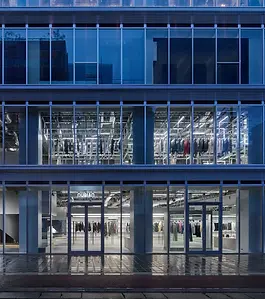

Glimpsing House
and to Architects
At a 321.90 m² house in Tokyo, and to Architects uses a U-shaped volume around a northern garden, spatial shifts from 2350 to 7050 mm and tactile materials including bamboo-board concrete to translate Noh cadence and the changing expression of a mask into an architecture of glimpses.

Caminito del Rey Visitor Reception Center
Luis Machuca Arquitectos
At a 550 m² visitor centre in Ardales, Spain, Luis Machuca Arquitectos abstracts the gorge through demountable glulam portals, combining off-grid photovoltaics, earth-tube cooling and a sequence from shadow to reservoir horizon as a prelude to the Caminito del Rey.


Colere 1600 by Cloud 7 Hotels
P2A Design
At 1,600 metres above Colere, P2A Design transforms an existing 2,800 m² mountain building with Orobie stone, timber and continuous south-facing glazing, reorganising 28 rooms, dining, wellness and shared spaces as an all-season destination rather than a seasonal ski stop.

HAMANOYU EDOYU
Kubo Tsushima Architects
At the base of a ten-storey, 1,592.55 m² mixed-use building in Nihonbashi-Hamacho, Tokyo, Kubo Tsushima Architects uses layered roofs and ceilings to screen surrounding views and moderate natural ventilation, allowing the semi-open-air baths to retain a gentle sense of breeze, daylight and moving water within the dense city.


Itsumo Dessert Shop
Kousou
In a 300 m² shop-house renovation in Batam, Kousou inserts a new frame within the existing concrete structure, reorganising three floors around a RAIN VOID where a long skylight, channelled rainwater and bankirai hardwood reconnect the brand's original home with the tropical climate.

House in Oiso
ISO architects & associates
In a 98.33 m² single-storey timber house in Oiso, ISO architects & associates pairs an almost equally sized living-dining-kitchen space and inner courtyard, using an engawa, deep eaves, an earthen terrace, rising beams and a continuous cedar wall to draw light, breeze and material change into life after retirement.

Common Days Cafe
INS Studio
In a 269 m² three-storey cafe in Maros, Indonesia, INS Studio links a social ground floor, an upper coworking level and a rooftop garden, using local andesite, terracotta screens, a moss wall and natural ventilation to turn an everyday visit into a gradual ascent toward Bukit Cenrana.

GEMMYO Tokyo Boutique
Fumihiko Sano Studio
In a 90 m² jewellery boutique in Jingumae, Tokyo, Fumihiko Sano Studio uses a freestanding frame of octagonal cedar posts and beams to organise reception and three guest rooms, bringing marble ceilings, French herringbone flooring, Kyo Karakami paper, Nishijin textiles and a Rokko-stone display into a restrained dialogue between Japanese and French culture.

Holiday House in Rågeleje
Jesper Kusk Arkitekter
At a 158 m² timber holiday house in Rågeleje, Denmark, Jesper Kusk Arkitekter uses a north-south longhouse to connect a narrow hillside plot with the public beach, while sheltered east-west terraces, ridge skylights and Danish oak surfaces allow the sea to unfold gradually through arrival and everyday life.

THE CONE
KAMIYA ARCHITECTS
At a 380.41 m² shared villa in Karuizawa, KAMIYA ARCHITECTS uses an inverted-conical roof and curved corridor to mediate collective and private life, while a 15-by-12-metre living room, reflective white ceiling and three-tonne stone fireplace give brief stays a lasting sense of belonging within the seasonal forest.

SHIJI COMMONS
StudioTiltedCircle
At a 321 m² community venue in Hengshiji Village, Zhuhai, StudioTiltedCircle renews two traditional stone houses with reclaimed masonry, layered concrete and lightweight metal, using a central light-filled passage, folding polycarbonate doors and a roof terrace to support cultural events, a café and everyday village life.

Torinago
ninkipen!
At a 390.71 m² headquarters for Fukuchiyama chicken restaurant Torinago in Kyoto, Japan, ninkipen! combines a tiled roof, charred-timber walls and a raised watchtower to connect the castle town, the Yura River and surrounding mountains with kitchen, office, terrace and forecourt spaces.

La Vigilia Winery
González Olsina & Vega Arquitectos
At a 1,700 m² winery in Los Chacayes, Argentina, González Olsina & Vega Arquitectos use a central axis, Corten steel and darkened concrete to shape a contemporary temple facing the vineyards and the Andes, turning winemaking into an experience of volume, light and shadow.

BIRKENSTOCK SHINSAIBASHI
TORAFU ARCHITECTS
TORAFU ARCHITECTS transforms a 238.14 m² concept store in Osaka’s Shinsaibashi district into a tactile account of walking, using earth-infused washi, hovering timber pieces, a hand-stitched leather rail and facing mirrors to extend the route beyond its physical limits.

Fonds Bustamante
Charles Zana
In the transformation of Arles’ former Église Sainte-Croix, Charles Zana uses retained masonry, a bronze-toned lattice entrance, corrugated aluminium ceilings, a terracotta stairwell and locally crafted terrazzo to organise three levels of galleries, keeping the building’s accumulated history in active dialogue with the contemporary programme of Fonds Bustamante.

Centre Pompidou Hanwha Seoul
Wilmotte & Associés
In the approximately 12,000 m² renewal of the 63 Building podium on Seoul’s Yeouido Island, Wilmotte & Associés uses a 150-metre curved-glass box of light, a daylit central hall, sculpture garden and paired exhibition zones to turn a former commercial-events base into a public cultural frontage linking art, the Han River and everyday city life.

Theodore Roosevelt Presidential Library
Snøhetta
At an approximately 8,919 m² presidential library in North Dakota, Snøhetta combines an accessible prairie roof, a nearly mile-long boardwalk, local rammed earth and a timber-steel structure to turn architecture, exhibition and Badlands ecology into one continuous public experience.

Zannier Île de Bendor
Hardel Le Bihan Architectes
Across a 13,500 m² renewal of Île de Bendor in France, Hardel Le Bihan Architectes, Niez Studio and Zannier Hotels reconnect the harbour settlement, Mediterranean ecology and public island life through repair, restrained additions, landscape recovery and varied hospitality spaces.


NYMA Water Tower
Eek en Dekkers
Inside an 800 m² industrial water tower built in Nijmegen in 1929, Eek en Dekkers uses a vertical glazed incision, detached steel stair and timber insertions to organise a restaurant, meeting spaces and panoramic bar, making public life visible within the repaired concrete frame.


C+C House
Studio Maignan Architects
Studio Maignan Architects transforms an approximately 353 m² 1930s brick house in Toronto through a kitchen and dining core that steps down to the garden, a frameless glazed corner, an exposed hemlock ceiling and a third-floor studio, reconnecting work, gathering and outdoor life.

Blue Bottle Coffee Harajuku
TEKI Design
In an 82.95 m² cafe in Harajuku, Tokyo, TEKI Design draws the alley into the interior through a continuous stainless-steel surface. Layered plaster walls, a pale blue reflective ceiling, and soft lighting create an inhabitable “slice of sky” between the surrounding buildings.

Sanduteca – Sandwich Library
Estúdio Cajalima
In a 60 m² space within São Paulo’s Galeria Metrópole, Estúdio Cajalima uses an open sandwich-making counter to connect sightlines between the ground floor and mezzanine. White ceramic tiles, red pigmented cement, blue perforated metal, and stainless steel transform this “library of flavours” into a visible theatre of preparation.

Curtain House
Johnsen Schmaling Architects
In a 307.14 m² narrow urban residence in Milwaukee, Johnsen Schmaling Architects uses progressively rotated wood-aluminium composite louvers to balance daylight, privacy, and solar shading on the south-facing facade, while reorganising three levels of family life around a linear courtyard.

Urban Revivo Sanlitun Flagship Store
MVRDV
In a 4,120 m² four-storey flagship in Beijing’s Sanlitun district, MVRDV brings together a colour-shifting aluminium-tile facade, seven moon-gate openings and six Bold Rooms to create a retail narrative that gradually transforms traditional forms into contemporary abstractions.

House in Nikko
Atelier MEME
Atelier MEME arranges cubic volumes of varying sizes along a spiral plan for this 145.75 m² timber house in Nikko, Japan. Rooms are tucked into rock-like masses, while the living and dining areas unfold through the spaces between them. Small openings, shifting ceiling heights and an integrated waterproofing system respond to the mountain landscape, neighbouring privacy and the family's evolving way of life.


Urban Egg
U.GA Architects
Urban Egg stands in Jeonpo-dong, Busanjin-gu, Busan, where a district of small factories and warehouses has gradually become the commercial and cultural quarter known as Jeollidan-gil. Confronted by narrow lanes, dense buildings and competing urban signals, U.GA Architects did not treat the 454 m² mixed-use facility as an isolated object. It is conceived instead as a refuge within the city: a layered concrete shell that makes room for pause, accommodation and recovery amid the surrounding intensity.

JNG House
BodinChapa Architects
JNG House is a 446 m² private residence in Bangkok, developed by BodinChapa Architects through a long conversation with its owner. Complexity was never the point. The masterplan, circulation, atmosphere and material palette were refined around the family's routines and their capacity to change over time, with unnecessary elements gradually removed.


Villa Suki
Alexis Dornier
Villa Suki stands in Pererenan, Bali, and was designed by Alexis Dornier. A perfect square is rotated 45 degrees within the near-rectangular plot, creating a family of triangular gardens between the house and its boundaries. Landscape is not treated as a leftover perimeter. Together, the central void and peripheral gardens establish the order of a tropical residence that looks outward while remaining anchored by a quiet interior core.

Nachan the Antique Courtyard Hotel
PAVA architects
Nachan the Antique Courtyard Hotel stands in Chiang Khan, northeastern Thailand, near the Mekong River. Rather than concentrating its 1,200 square metres in a single resort building, PAVA architects breaks the programme into intimate timber units arranged around a series of triangular courtyards. The resulting cluster reads as a small village, forming a gradual transition between an urban pace of life and the stillness of the river landscape.

TOM WOOD SHIBUYA
TORAFU ARCHITECTS
TOM WOOD SHIBUYA occupies a street-level space in Tokyo and is the Norwegian jewellery brand's second flagship store in Japan. In a district saturated with movement and visual information, the shop is not treated as a sealed display box. A portal-like frame gives the entrance a clear civic presence, allowing the street, the interior and the brand's restrained material language to meet in a single view.

Art Museum of AHUA
TJAD + DCA
The Art Museum of AHUA stands beside the lake at the south-eastern edge of the university campus in Hefei, close to the School of Fine Arts. A professional museum often depends on opaque walls, artificial lighting and uninterrupted display surfaces to create a controlled “black box”. Here, that enclosure conflicts with the openness of daily teaching, student exchange and an exceptional lakeside setting. The design turns this tension into the starting point for its spatial organisation.

Yuiichimi Processing Facility and Shop
FUMIASO ARCHITECT & ASSOCIATES
Yuiichimi Processing Facility and Shop occupies part of an existing house in Nishinomiya, Hyogo, where FUMIASO ARCHITECT & ASSOCIATES created a small place for processing and selling chilli products. Rather than turning the whole residence into retail space, the project gives a family-run product a distinct public threshold within a timber house that is around two decades old.

TU Munich Kinderoase Daycare
Kéré Architecture + HK Architekten
Located on the main campus of the Technical University of Munich, TU Munich Kinderoase Daycare by Kéré Architecture and HK Architekten is conceived as a vertical kindergarten. On a compact and noisy urban site, the project creates a timber play environment for 60 children while offering a more humane link between work, research and family care.

Casa Co
Aagnes studio + JDEstudio
Casa Co is located in Guadalajara, Mexico, with architecture by JDEstudio and interiors by Aagnes Studio. Although the project unfolds at the scale of a private house, it places beauty back at the center of architectural thinking: not as surface decoration, but as an ordering force for space, material, light, and the rhythm of domestic life.

PERMA Serifos Retreat
MOLD Architects
PERMA Serifos Retreat is set into a rocky north-facing slope on Serifos Island, Greece. Designed by MOLD Architects, the project consists of five residences and is conceived less as a freestanding building than as a measured piece of terrain made habitable, embedded within the island's rugged ground, sea views and dry vegetation.

Terra Catarina House
Nola Arquitetura
Terra Catarina House is located in the mountain landscape of Campo Alegre, Brazil. Designed by Nola Arquitetura, the 600-square-metre residence sits among dense araucaria forest and opens toward a valley shaped by a Permanent Preservation Area. History, memory, nature and architecture are brought together as the house becomes a countryside refuge for family life.

Cerdeiras House Hotel
Tiago do Vale Arquitectos
Cerdeiras House Hotel is located in the Labruja Mountain area of Ponte de Lima, Portugal. Designed by Tiago do Vale Arquitectos, the project transforms an 18th-century rural ensemble into a hotel, working with surviving granite and schist walls, a reconstructed granary, courtyards, terraces, and views toward the Labruja River valley and the nearby Sanctuary of Senhor do Socorro.

Dymak HQ
BIG
Located in Odense, Denmark, between an industrial district and the natural landscape around Glisholm Lake, Dymak's new headquarters by BIG - Bjarke Ingels Group is conceived as a circular building wrapped around a sheltered green courtyard. The 2,800-square-meter headquarters brings offices, showrooms, a photo studio, fitness facilities, and shared spaces into a daily environment shaped by daylight, landscape, and social interaction.

NANZUKA TAKEN
SNARK Inc.
SNARK Inc. has completed NANZUKA TAKEN, a dining and bar space in Shibuya, Tokyo. Operated by the contemporary art gallery NANZUKA, the art bar was planned in collaboration with multiple artists, bringing together two sharply contrasting atmospheres: a main bar that evokes outer space, and a timber-lined VIP bar concealed beyond it.

The TH Villa Hoi An
85 Design
85 Design has completed The TH Villa Hoi An in Vietnam, a coastal villa conceived as both a family retreat and a flexible hospitality-oriented residence. Located on Nguyen Phan Vinh Street in Tan Thanh, Hoi An, near the transition zone of the city’s heritage core, the 610-square-metre project sits within a seaside setting where domestic life, guest accommodation and the surrounding seascape are intended to coexist.

Sublime Comporta Sand
Fragmentos
Fragmentos has completed Sublime Comporta Sand in Grândola, Portugal, a hotel project set within cork oak and umbrella pine forest in Comporta. Occupying a 51-hectare natural site, the project marks the next chapter of Sublime Comporta, one of Portugal’s most recognisable hospitality destinations. Rather than functioning as a simple extension, it establishes a new layer of resort experience through a more complete spatial organisation and a clearer relationship with the landscape.
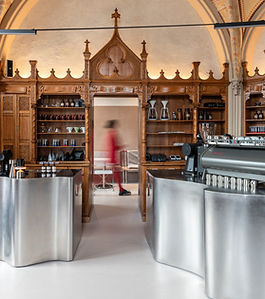
Laboratorium Coffee Shop
EktraArhitectura
EktraArhitectura has completed Laboratorium Coffee Shop in Cluj-Napoca, Romania, transforming a late 19th-century pharmacy into a contemporary coffee space. The project occupies the ground floor of Palatul Széki, a corner building in the heart of the city and the former home of Matia Corvin Pharmacy, once part of an important threshold into the historic centre.
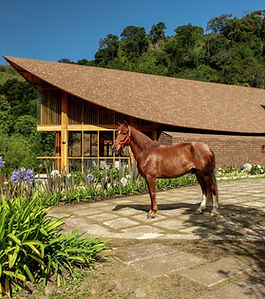


Beymen Tersane
OMA
OMA has completed Beymen Tersane, a new department store for Turkish luxury retailer the Beymen Group, housed within a cluster of former imperial shipbuilding halls along Istanbul's Golden Horn. The project marks the Dutch firm's first completed work in Turkey and stands as one of the most compelling examples of adaptive reuse in the country's recent architectural history.


House with a Large Roof
Yaita and Associate Co., Ltd.
Perched on a sun-drenched slope in Kitasaku, Nagano, this family residence by Tokyo-based Yaita and Associate Co., Ltd. demonstrates how a single sweeping roof can transform a hillside into a place of profound spatial richness. Designed for a family relocating to the Karuizawa area, the house occupies a southeast-facing incline pitched at approximately thirty degrees. Rather than resist the gradient, architects Hisaaki Yaita and Naoko Yaita embraced it, draping a generous roof across the slope and orchestrating a layered sequence of interior and exterior space beneath it.

On Cloud9 HDY Cafe
Sitti Architects and Design
Thai studio Sitti Architects and Design has completed a healthy café and restaurant in Hat Yai that distils the owner’s brief — “simple yet truly outstanding” — into a striking architectural statement of curved concrete and open sky. Situated within a densely populated residential neighbourhood in southern Thailand, the 200-square-metre project was completed in 2026, deploying a bold circular plan to create an inward-looking sanctuary.

Layer House
W O V E N Architecture and Design
Perched on a forested hillside above the shimmering waters of Saanich Inlet in Willis Point, British Columbia, Layer House is a 6,477-square-foot waterfront residence designed by Vancouver-based studio W O V E N Architecture and Design. Completed in 2025, the project was conceived for a visual artist and craftsperson who sought a home that holds equally the demands of creative work and quiet contemplation.
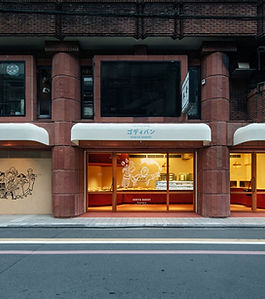
GODIVA Bakery Godipan Kyoto Shijo
Torafu Architects
Tokyo-based practice Torafu Architects has completed GODIVA Bakery Godipan Kyoto Shijo, a compact retail bakery for the Belgian chocolate brand GODIVA, positioned adjacent to the historic Nishiki Market in central Kyoto. The 101-square-metre shop translates the spatial language of the Tokyo flagship in Yurakucho into a response specific to Kyoto’s layered urban fabric, distilling the brand’s guiding concept — a neighbourhood bakery meets GODIVA — into a space that feels simultaneously festive and rooted in the everyday.

i8 iCampus
C.F. Møller Architects
Completed in 2025, i8 is C.F. Møller's latest contribution to Munich's rapidly evolving Werksviertel district — a 20,000-square-metre office building that redefines what a contemporary workplace can be. Positioned at the threshold of the quarter, the building operates as a deliberate gateway, its muted green anodised aluminium facade evoking the surrounding forest while anchoring itself firmly in the industrial memory of the site. The recycled cladding, modular in composition and precise in execution, wraps three distinct office zones beneath a single unifying skin — a formal move that projects coherence without sacrificing internal diversity.

The Wood Cabin
S.O.S Architects
Nestled within the forested highlands of Chiang Rai, Thailand, The Wood Cabin by S.O.S Architects is a 705-square-metre commercial retreat that redefines the relationship between built form and natural landscape. Completed in 2026, the project is led by architects Chaikla Dangboon and Tariya Tiwan, whose guiding ambition was to dissolve the boundary between architecture and its environment rather than assert a building against it.
House with a Mountain View
Stempel & Tesar Architects
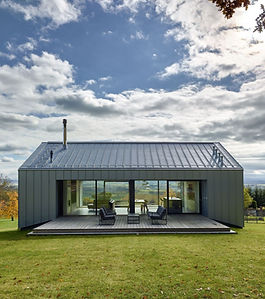
On the rural edge of Klatovy in the Czech Republic, Stempel & Tesar Architects have completed a family home that treats landscape not as backdrop but as the organizing force behind every architectural decision. Positioned on sloping terrain at the boundary between village and forest, the 246-square-metre house negotiates its site with quiet intelligence, embedding itself into the hillside to minimise its visual presence while maximising its connection to the panoramic mountain horizon beyond.


House M
KAMIJIMA Architects
KAMIJIMA Architects has completed House M, a residential rebuild located in a scenic preservation district of Tokyo for a client who works in horticulture. The project transforms a private dwelling into a measured threshold between domestic life and the surrounding neighbourhood. Its conceptual point of departure is a straightforward observation: the rare and unusual plants cultivated in the client's previous garden had long served as catalysts for informal exchange with local passersby.


Iporanga House
Nati Minas & Studio
Nestled within a protected stretch of Brazil's Atlantic Forest, Casa Iporanga is a masterful renovation by São Paulo-based practice Nati Minas & Studio that transforms an existing modernist beach house into a precision-tuned retreat for contemporary living. Completed in 2026 and located in Guarujá, the 750-square-metre residence demonstrates how sensitive intervention can deepen a building's relationship with its landscape rather than override it.
House Y
Mikazuki Architects
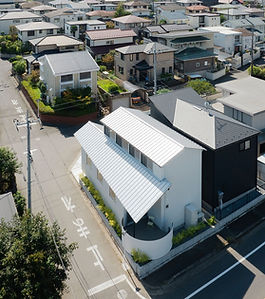
House Y, designed by Takashi Yamaguchi of Mikazuki Architects, is a private residence for the architect himself, situated in a quiet suburban neighbourhood in Chiba, Japan. Completed in September 2025, the project emerges from a deeply personal investigation into what it means to live richly in an environment that is, at first glance, unremarkable.

Purple Brand Operations Studio
Scott & Scott Architects
Scott & Scott Architects has transformed a 1973 warehouse in Vancouver’s Mount Pleasant industrial district into a working studio for denim label Purple Brand, delivering a 1,300-square-metre interior that channels the brand’s affinity for raw materiality and utilitarian precision. The space accommodates operations, design, archives, sample storage, photography, and meeting areas within a single, continuously functioning atelier.

House of Birds (torinoie)
Yumiko Tokuno Architecture Office
Tucked into a narrow residential plot in western Japan, the House of Birds by Yumiko Tokuno Architecture Office challenges the conventional anxieties surrounding compact urban living. Measuring just 4.3 metres wide and 14.3 metres deep, the site is hemmed in on three sides by neighbouring buildings — yet the architect has responded not with compromise, but with quiet invention.

Casa Luce
HK Associates Inc
Casa Luce is a comprehensive renovation of a 1960s mid-century modern residence in the Catalina foothills of Tucson, Arizona, originally conceived by local modernist architect Tom Gist. Led by principals Kathy Hancox and Michael Kothke of HK Associates Inc, the project is guided by a single, overriding ambition: to flood the heart of the home with natural daylight and reorient a formerly introverted dwelling outward toward the desert landscape and distant horizon.

Teshima Factory
Schemata Architects
Japanese architect Jo Nagasaka of Schemata Architects has transformed a disused ironworks on the island of Teshima, in Japan's Seto Inland Sea, into a working cafeteria and food production facility that honours both the industrial memory of the building and the ecological identity of its island setting.

LARUNS
Mesnil Architectures
At the southern end of the Ossau Valley, where the terrain opens toward the Pyrenees, Mesnil Architectures has transformed a former automobile repair workshop into a 150-square-metre artist's residence. The building's unusual ground-floor height and the former office space above together defined the terms of the intervention. When successive layers of finishes and suspended ceilings were stripped away, a timber-framed structure re-emerged at its original generous proportions, its accumulated traces of former use becoming the raw material for a new spatial narrative.

Ebara Apartment Complex
Plus Maizumi Architect
In a narrow, irregularly shaped residential plot in Ebara, Shinagawa, Tokyo, architect Yosuke Maizumi of Plus Maizumi Architect has completed a compact twelve-unit rental apartment building that transforms one of urban housing's most persistent challenges, confined and lightless interiors, into a study of luminous spatial ingenuity.

House in Zenpukuji Park
KIAS
KIAS Ishida Architects Studio has completed a residence in Suginami, Tokyo, that quietly redefines the boundary between private dwelling, artistic community, and public parkland. Sited directly opposite the verdant Zenpukuji Park, the two-storey timber structure integrates a rental gallery for emerging artists on its ground floor with the owner's home above, creating a rare hybrid building that serves both its inhabitant and its neighbourhood with equal intention.

Moksha House
SAW
Perched above Portola Valley in Northern California, Moksha House is a meditation on grief, renewal, and the passage of time, designed by San Francisco studio SAW for a family marked by profound loss. Named after the Sanskrit concept of liberation from the cycle of life and death, the project carries its emotional weight directly into its architecture, making it one of the most deeply personal residential works to emerge from the American West Coast in recent memory.
Houses of Stealth
SpActrum
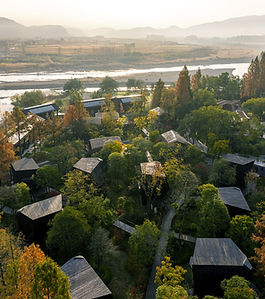
Completed in January 2026 within a forested site in Hangzhou's Tonglu district, the Houses of Stealth resort is the work of SpActrum lead architect Yan Pan, commissioned by Tonglu Tourism Investment and Kaiyuan Cultural Tourism. Across a building area of 705 square metres set within a 5,740-square-metre site, the project is a masterclass in restraint. Rather than imposing a dramatic overhaul on a landscape that had accumulated twenty years of organic growth, the architects made the radical choice to disappear into the forest, letting the trees take the lead.

Limberlost Place
Moriyama Teshima Architects
Limberlost Place rises ten storeys above Toronto's eastern waterfront as the campus building commissioned by George Brown College, designed by Moriyama Teshima Architects in joint venture with Acton Ostry Architects, and completed in 2025. Widely regarded as the world's first tall timber public building, the 203,330-square-foot structure accommodates George Brown College's School of Architectural Studies, the Brookfield Sustainability Institute, executive offices, a fitness centre, a daycare, and an event space, with a student capacity of 3,400.

Tremolare
Fumihiko Sano Studio
Descending a staircase from the street above, visitors to Tremolare find themselves transported into an entirely different world. Located in the basement of a building in Nishi-Azabu, Tokyo, this Italian restaurant was designed by Fumihiko Sano Studio, who drew their inspiration directly from the raw, cavernous quality of the existing space.

PCG House
Visioarq Arquitectos
Nestled within the sun-drenched landscape of Loulé, Portugal, PCG House by Visioarq Arquitectos is a masterful exercise in geometric precision and environmental sensitivity. Completed in 2024 and spanning 418 square metres, the residence stands as one of the most compelling examples of contemporary Iberian residential architecture to emerge this year.
Vesp House
Story Architecture
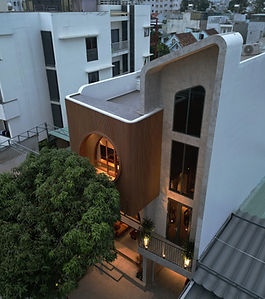
Nestled within the dense urban fabric of Ho Chi Minh City, the 160-square-metre Vesp House by Story Architecture is a deeply personal dwelling that transforms the nostalgia of a lifelong passion into inhabited space. Designed for a young man with a profound love for vintage Vespa motorcycles, the house does not merely shelter its occupants — it holds their memories, habits, and aspirations within its walls. A front yard is carved out of the tight site to provide the homeowner with a place to care for and display his beloved Vespas, anchoring a private emotional narrative at the very threshold of the home.

HarPie
Nathalie Thibodeau Architecte
Nestled between a lakeshore and an access road on a narrow strip of land in Wentworth, Canada, the HarPie residence by Nathalie Thibodeau Architecte is a masterclass in contextual sensitivity and restrained contemporary design. Completed in 2025, this 6,350-square-foot lakeside home demonstrates how architecture can be simultaneously rooted in its landscape and boldly of its time.

The House of Time
Natura Futura
The House of Time is located in Babahoyo, the capital of Ecuador's Los Ríos province, a city whose identity is historically and culturally inseparable from the river that runs through it. One of the most significant built works to emerge from Natura Futura Arquitectura's practice in recent years, the project occupies a modest 180 square metres yet constitutes a rigorous argument against the accelerating logic of contemporary construction, assembling a residential space in which slow living, artisanal heritage, and ecological attunement are made architecturally legible.

NOT A HOTEL Setouchi
BIG
Bjarke Ingels Group has completed its first built works in Japan, unveiling three rammed earth villas on the remote island of Sagishima in the Seto Inland Sea for luxury hospitality brand NOT A HOTEL. The project, known as NOT A HOTEL Setouchi, marks a significant milestone for the Copenhagen-based practice, blending Scandinavian design sensibility with deep reverence for Japanese architectural tradition.

Azumigawa House
atelier umi
The Azumigawa House stands within the Biwako Quasi-National Park in Takashima City, Shiga Prefecture, Japan, making it one of the most quietly compelling residential projects to emerge from the Kansai region in recent years. Designed by principal architect Fujita Tokihiko of atelier umi, the single-storey timber residence occupies a generous plot of over 1,200 square metres, and translates the client's foundational ambition, to live inside a forest, into a precise and restrained spatial order.

Casa Komorebi
Studio Saxe
Perched high above the Pacific coastline of Bahia Ballena, Casa Komorebi is one of the most compelling residential projects to emerge from Costa Rica in recent years. Designed by Studio Saxe under Lead Architect Benjamin Saxe, the 470-square-metre home redefines what it means to live in harmony with a tropical landscape through a rigorously resolved architectural strategy.
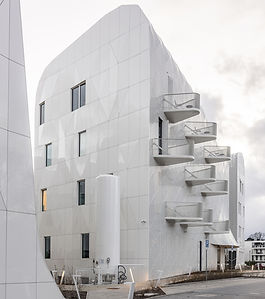
Wave 4 & 5 – ECR Health Care Complex
FAAB
Located just 400 metres from the Baltic Sea in Sopot, Poland, the Wave 4 and 5 buildings of the ECR Health Care Complex by Warsaw-based studio FAAB represent a decisive shift in how healthcare architecture can function as a therapeutic instrument. Completed in 2025, the 4,744-square-metre project accommodates an analytical laboratory, outpatient clinic, day surgery hospital, and specialist hospital, all united beneath a cohesive architectural language rooted in the healing potential of the natural world.